
What is swing trading and what strategies to use. Examples

Warning. Any strategy does not guarantee profit on every trade. Strategy is an algorithm of actions. Any algorithm is a systematic work. Success in trading is to adhere to systematic work.


Attention: (Images may not display. Hover your mouse over the image icon. Right-click to open in a new tab)


Swing trading (swing trading, свинговая торговля) is a method of trading on financial markets that involves holding a position for several days or even weeks. It aims to profit from expected “swings” – price fluctuations that form longer trends than intraday impulses. This usually happens against the backdrop of significant news.

The concept of swing trading was introduced by J. Douglas Taylor in his book “The Taylor Trading Technique” (1950). Taylor analyzed the directional movements of the market, breaking the sequence of candles into individual cycles.

He described his theory of the “three-day cycle,” highlighting buying and selling days, which became the foundation for swing trading.Swing trading does not guarantee profit, but it can enhance your experience in financial markets if active intraday trading does not suit you for some reason.

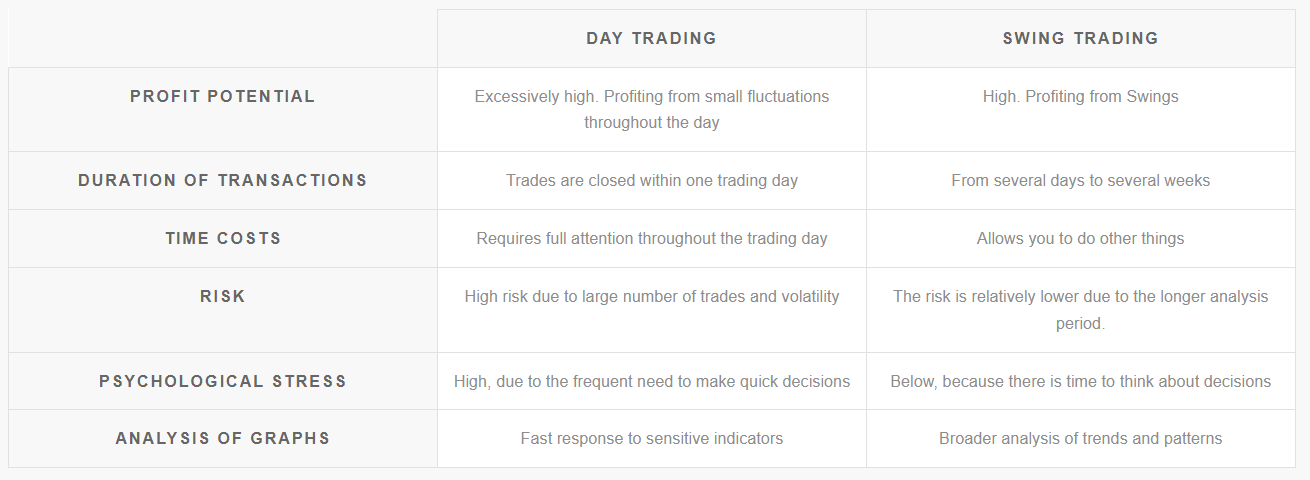
Swing trading allows traders to find a unique balance between the frequency of trades, commission costs, emotional stress, the number of instruments tracked, and the time spent on analysis.Swing trading involves higher risks as it requires wider stop-losses to account for volatility. A swing trader may also face the need for a higher starting deposit to hold positions overnight.


Who is swing trading suitable for?

Swing trading is suitable for those who want to maintain an active presence in various markets without dedicating all their working time to it. Let’s list several categories for whom this type of trading is optimal:

Busy professionals
Swing trading does not require constant market monitoring throughout the day, allowing traders to combine trading with their primary job. For example, Dr. Alexander Elder successfully combined his career as a psychologist with trading.

Beginner traders
Swing trading is less stressful compared to day trading and does not require quick decision-making. This trading style allows beginners to gradually assimilate the basic principles of analysis and learn to manage risks, which is optimal for newcomers.

Investors
For instance, if you hold a long-term position in cryptocurrencies but observe signs of weakness near a significant resistance level, anticipating a correction in the coming days, you can open a swing short position without selling your long-term position. Thus, swing trading enables more efficient use of capital compared to long-term investments.

Enthusiasts of various analysis methods
Swing trading allows traders to combine technical analysis (such as chart patterns) and fundamental analysis (the reaction of prices to important news releases).

Do you want to understand if swing trading is suitable for you? Then keep reading – we will analyze the pros and cons of this trading style and explore the most effective strategies through examples.
An example of a swing trade:

In swing trading, the primary focus is on daily and 4-hour charts, though smaller timeframes can also be used to refine entry points and/or gain additional confirmation.

Example of a swing trade in the futures market:

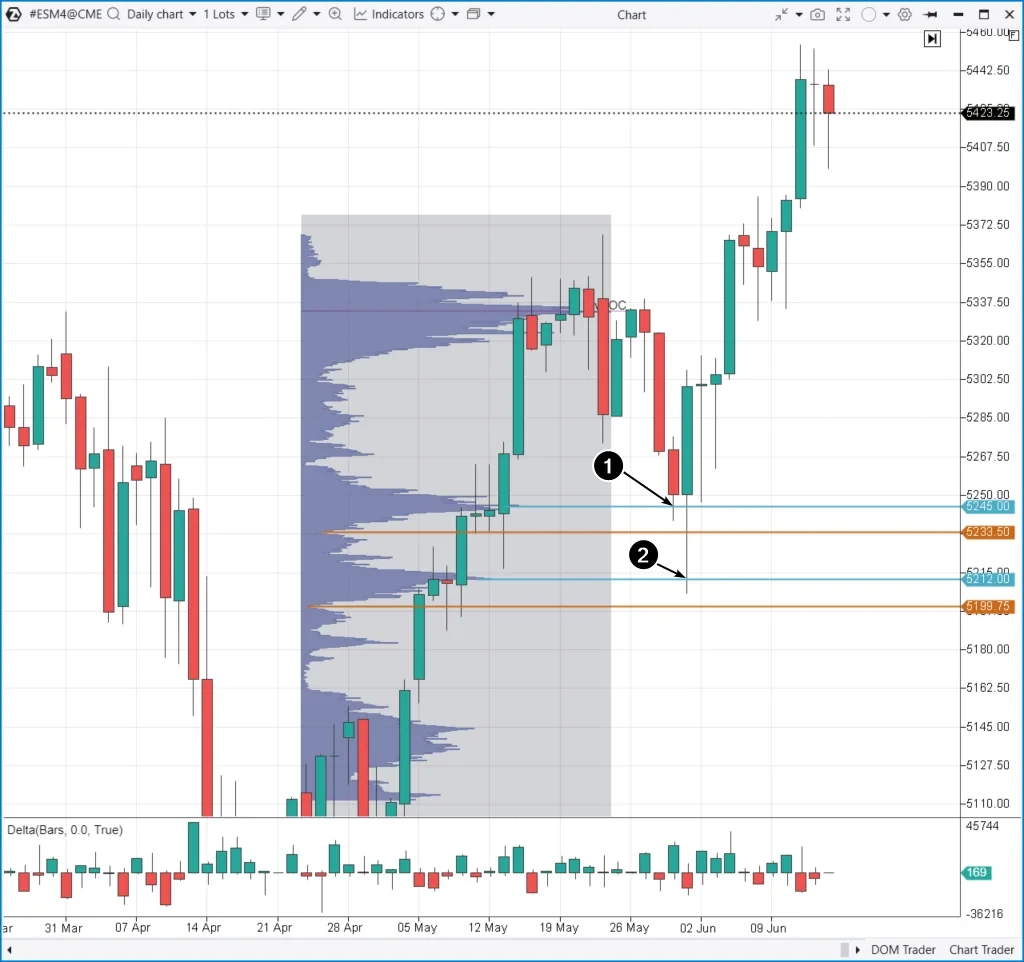
Imagine a swing trader notices a steady uptrend that unfolded in late April and early May (this period covered using a graphical tool for arbitrary profile) in the E-mini S&P 500 futures market.

During an upward movement, two peaks formed on the profile at levels 5245.00 and 5212.00 (marked with turquoise lines). Let’s say a swing trader placed 2 buy-limit orders there with stops at 5233.50 and 5199.75 (marked with light brown lines), anticipating that the uptrend would continue after testing these significant volume levels.

As charts often show, prices frequently react to such levels.

Returning to the example: Near the previous peak formed in late March, the uptrend slowed, and fundamental news about weak US labor market conditions led to subsequent price declines, triggering the execution of 2 buy orders:

  • Swing trade long #1 was closed at a stop-loss (minus 46 ticks) the day after opening.
  • Swing trade long #2 may still be active (+650 ticks), for instance, using a trailing stop.

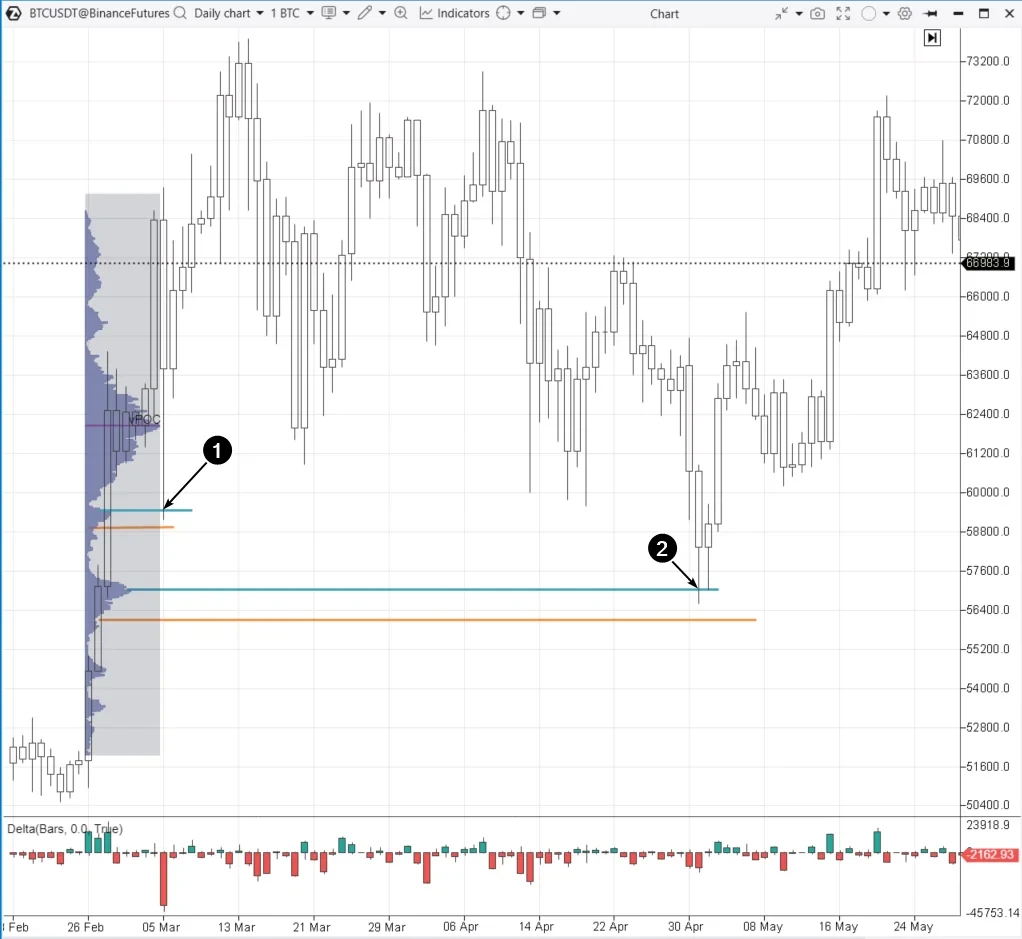
Example of a swing trade in cryptocurrencies:

During a sharp price surge starting on February 26 in the Bitcoin market (as shown by an 8-day profile), two noticeable peaks formed (marked with turquoise lines).

A swing trader could have placed limit buy orders (with protective stops around the orange lines where the profile thins out), expecting the price to turn upward if it retraces to these peaks.

The calculation turned out to be correct: in both cases, there was an upward reversal without triggering the stop losses (although for the second setup to work, the swing trader had to wait for 2 months – quite a long time for a scalper).

Closing a position can be done:

→ near important resistance levels (horizontal or sloping);
→ using trailing stops;
→ mathematically, for example, setting a stop loss so that the potential reward exceeds the risk by 5-10 times;
→ using other methods.

WHAT INSTRUMENTS ARE USED IN SWING TRADING

Reliable instruments are a way to maintain stability in the conditions of intense competition in markets, where your profit often means the loss of another participant in trading.”

Well-applicable tools:

  1. Market Profile: Allows analysis of trading volume distribution at price levels, identifying key support and resistance levels. Helps determine where the main zones of market activity and interest of market participants were located.
  2. Price Alerts: Allow traders not to miss important moments for entry or exit from a trade, while engaging in other activities without tracking price dynamics.
  3. Volume and Delta: Contribute to assessing the market in terms of effort and result, helping to judge the balance of supply and demand.
  4. Footprint Charts: Show information “inside candles” about trades, including volume and direction, at each price level. For example, footprints on a daily timeframe can be valuable for swing traders.
  5. Margin levels: Margin zones typically serve as important support and resistance levels.
  6. Non-standard types of charts – for example, ranges. They allow filtering out market noise and focusing on changes in short-term trends.
  7. ZigZag Pro indicator: Allows breaking down candle sequences into waves, including statistics for each wave.
  8. Wave analysis: Elliott Wave principles and other wave analysis tools can be used on higher timeframes to determine the current stage of the market and the potential direction of the next swing.
  9. Economic calendars: Provide information on upcoming economic events and indicators that could impact markets.

Highly sensitive Order Flow indicators:

  1. For instance, Depth of Market (DOM), which displays market depth, order volumes for buying and selling at different price levels. While beneficial for scalpers due to its ability to reflect instantaneous market activity, it is less effective for swing trading because market conditions change rapidly.
  2. Indicators reflecting order book activity: These can assist swing traders in finding precise entry points (thus reducing risks), but they are unlikely to alter a trader’s market perspective over a period of several days or weeks.
  3. Moving Averages (MA) for swing trading: Tools like moving averages and oscillators have debated effectiveness and cannot be recommended as reliable aids for making trading decisions. Research indicates their predictive ability is often limited.
  4. Trading rules based on MACD and RSI indicators: Trading strategies relying on indicators like MACD and RSI do not always effectively predict price movements across various markets. This data confirms that while technical indicators can be useful under specific market conditions, they often generate false signals.

Swing Trading: Types of Strategies

Let’s consider the strategies applied by swing traders. For convenience, we will divide them into 2 key categories:

  1. Trend Trading.
  2. Counter-trend Trading (essentially involves trading against the trend).

Advantages of Swing Trading

  1. Moderate Time Commitment: Requires less time for analysis and monitoring positions compared to day trading. Traders can dedicate a few hours per week to the market, making it feasible to combine swing trading with a primary job.
  2. Moderate Volatility: Swing trading does not require reacting to every instant market fluctuation, unlike day trading, which helps in managing emotions and making more deliberate trading decisions.
  3. Potential for Significant Profits: Trends in swing trading can persist longer than expected, allowing for substantial profits by capitalizing on short-term trends and market fluctuations.
  4. Flexibility in Instrument Choice: Suitable for trading a variety of financial instruments including stocks, currencies, futures, and cryptocurrencies, providing traders with diverse market opportunities.
  5. Variety of Strategies: Offers the flexibility to employ different trading strategies such as breakout trading, pullbacks, and trend-following, enabling traders to adapt to various market conditions effectively.
  6. Transaction Costs: Transaction fees and costs in swing trading have less impact on overall profitability compared to shorter-term trading strategies. However, it’s essential to consider these costs when planning a trading strategy.

Swing trading combines the advantages of flexibility and potential profitability with a moderate time commitment, making it appealing to traders looking to balance trading with other professional or personal commitments.


Disadvantages of Swing Trading
  1. Capital Intensive: Swing trading requires a larger starting capital due to wider stop-loss orders to withstand price fluctuations typical in swing trading. This capital requirement may also necessitate holding positions overnight.
  2. Gap Risk: Holding positions overnight or for several days (or weeks) exposes traders to the risk of price gaps caused by unexpected news events.
  3. Forecasting Requirement: Effective swing trading demands comprehensive market analysis, encompassing both fundamental analysis and technical analysis. Errors in judgment or analysis can lead to losses.
  4. Psychological Pressure: While generally less emotionally demanding than active day trading, swing trading still involves stress, particularly during periods of high volatility or anxiety over holding positions overnight.
  5. Continuous Learning Requirement: Swing traders need to continually update their knowledge and skills to adapt to market changes, requiring ongoing education and staying abreast of market developments.

Swing trading offers flexibility and potential profitability but comes with significant challenges related to capital requirements, risk management, market analysis, psychological resilience, and the need for continuous learning and adaptation. Traders must weigh these factors carefully when deciding whether swing trading aligns with their financial goals and risk tolerance.


BT

Loading